Christ As Bread
My Father gives you the true bread out of heaven.
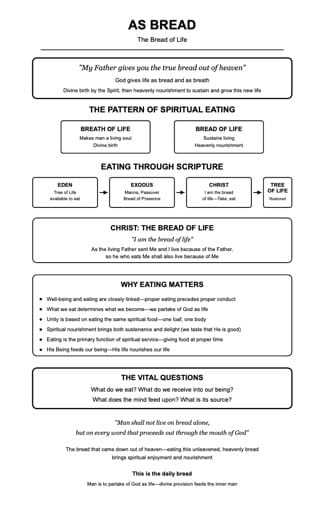
God gives life as bread and as breath. As the breath of life, He makes man a living soul. As the bread of life, He sustains living. The breath and the bread work together to give us life. First, there is the divine birth, and then there is the need for heavenly nourishment to support this new life in its growth and maturation.
Born of the Spirit and then fed by the Spirit. These two operations of the Spirit form and sustain spiritual life. Having created us in Adam as a living soul and further made us a new creation in Christ, God’s concern now is with man’s eating. What do we eat? What do we receive into our being? What does the mind feed upon?
Christ presents Himself as the unleavened bread, the living bread, and the bread that came down out of heaven.
“Take eat” - that was the simple instruction.
The theme of eating recurs throughout the Bible, and a review will impress us with its importance.
In Eden, God put man in a garden rich in provisions for food and positioned man to eat.
Jehovah God caused every tree to grow, which is pleasant to the sight and good for food.
The Tree of Life, a symbol of divine life, is also available. There is a single instruction about eating.
But of the tree of the knowledge of good and evil, of it you shall not eat.
The spiritual reality embodied in eating is a significant one. It is immediately evident in the opening scenes. God’s provision, permission, and prohibition all relate to eating. At first, the only commandment given concerned what not to eat. Humanity's future heavily depends on their choices about eating. Well-being and eating are closely linked.
In the exodus from Egypt, the Passover lamb and unleavened bread are eaten to provide strength for the journey.
And they shall eat the flesh in that night, roasted with fire, and they shall eat it with unleavened bread with bitter herbs. Seven days you shall eat unleavened bread.
This practice is continued in the first month of each year to remember divine deliverance. Ceremonial eating and holding of a feast unto Jehovah are established as a practice.
Manna from heaven and water from the smitten rock are provided in the wilderness. Once in the Good Land, the manna ceases, and the children of Israel eat the produce of the land. God feeds His people to undertake the journey until they are brought into the good land and begin to cultivate.
And Moses said to them, It is the bread which Jehovah has given you to eat. And the children of Israel ate the manna forty years until they came to inhabitable land; And the manna ceased on that day when they ate of the produce of the land;
The command regarding the Tabernacle is:
And place the Bread of the Presence on the table before Me at all times.
Along with the golden lampstand and the altar of incense, there is the bread of the presence in the Holy Place.
Both in the journey and in the destination, the aspect of eating is addressed. Well-being requires attention to spiritual nourishment through divine provision.
In Proverbs and Psalms, the experience of God is described as wine, oil, and bread.
Come, eat my bread and drink the wine I have mixed.
…wine that gladdens the heart of man, oil that makes his face to shine, and bread that sustains his heart.
The bread here is the one that sustains the heart. There is an invitation to come and eat.
In the New Testament, we have Christ’s promise of food that abides unto eternal life, which the Son of Man will give you. Christ presents Himself as I am the bread of life and as the Passover Lamb. Eating is still a primary concern, and the importance of manna and Passover as spiritually significant events remains. They are now imbued with a more profound and more present reality.
As the living Father has sent Me and I live because of the Father, so he who eats Me shall also live because of Me.
This is the bread which came down out of heaven, not as the fathers ate and died; he who eats this bread shall live forever.
Just before His crucifixion, Christ established the practice of eating together among the disciples. The church continued the practice of eating together in remembrance of Him.
While they were eating, Jesus took bread, spoke a blessing and broke it, and gave it to the disciples, saying, “Take and eat; this is My body.”
Serving the Master is also related to food. Faithful servants are set over the household by the master “to give them their portion of food at the proper time.” The primary function of spiritual service is to provide spiritual nourishment.
The apostles, considering their experience of Christ as the life-giving Spirit, see the wilderness narrative in a new light.
And all ate the same spiritual food, and all drank the same spiritual drink; for they drank of a spiritual rock which followed them, and the rock was Christ.
The historical journey is now a map for inner experience. The meaning and significance are spiritually interpreted.
Unity in diversity is based on eating the same spiritual food.
Because there is one loaf, we who are many are one body; for we all partake of the one loaf.
The food is one, and those who eat are one. Human communities are held together by gathering around food and having a similar diet. Now, a new spiritual community has been formed in Christ around the ‘one loaf.’
Believers ‘taste’ the Lord and are encouraged to continue feeding upon the word.
As newborn babes, long for the guileless milk of the word so that by it you may grow unto salvation if you have tasted that the Lord is good.
There is a good taste, a sensory experience, that motivates the spiritual practices; it is not merely a matter of necessity. The nourishment not only sustains but also delights.
Christ in Revelation speaks about eating as a reward to the overcomers.
To him who overcomes, to him I will give to eat of the tree of life, which is in the Paradise of God.
Blessed are those who wash their robes that they may have the right to the tree of life and may enter by the gates into the city.
The narrative around eating has come full circle. The tree of life in Genesis is also seen again in the Paradise of God. There is an inner reality symbolized as “eating” that is central to the interaction between man and God.
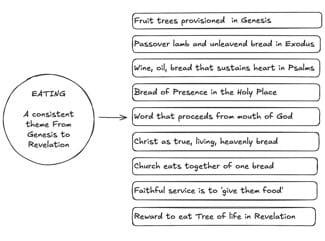
God feeds our being with His Being. There is spiritual food for the spiritual man. Eating and drinking are foundational to spiritual life.
God cautions us about our eating in Eden. A problem then arises due to unhealthy eating at the beginning. Ultimately, this problem is corrected through the overcomers being restored to healthy eating – the tree of life.
Proper eating is a more fundamental concern to God than proper conduct in the hierarchy of concerns. Improper conduct can be addressed by forgiveness. Such restoration can be instantaneous. Restoring a healthy eating habit requires time and attention from us. Errors in eating or a lack of eating cause problems. The resolution involves a return to proper eating. That is a theme that runs through the biblical narrative.
Positive and negative outcomes are closely tied to eating habits. In response to the temptation to use His power to provide for His need for bread, Christ had this to say:
Man shall not live on bread alone, but on every word that proceeds out through the mouth of God.
Overcoming temptation, as Christ did, is about recognizing the source of our living. What are we feeding upon? What is its source?
And this bread that I will give for the life of this world is My flesh.
Eating this unleavened, heavenly bread brings spiritual enjoyment and nourishment. There is a divine provision that feeds the inner man. His Being feeds our being. His life nourishes our life.
Man is to partake of God as life. This is the daily bread.